Pool waterproofing becomes urgent when the pool keeps losing water, damp patches appear around the shell, or water bills rise. Before applying any “quick fix”, it’s essential to confirm a real leak, locate it, and choose a repair system that matches the substrate and finish.
Is it a leak or just evaporation?
Rule out normal water loss first:
- Evaporation (higher with heat, wind, and warm water).
- Splash-out and filter backwashing.
- Level behavior: if the water drops to a certain point and then stabilizes, the leak is often at that height.
Quick check: mark the waterline and compare it after 24–48 hours with the pump off. A steady, significant drop suggests a leak.
Where pool leaks usually happen
Most losses come from:
- Skimmers, return inlets, lights, main drain (penetrations).
- Joints and transitions (coping-to-shell, steps, overflow channels).
- Shell cracks from movement, shrinkage, or settlement.
- Worn finishes (mosaic grout washed out, cracked paint).
How to locate a leak without tearing everything out
Finding the source drives the right repair:
- Visual inspection: cracks, loose fittings, failing joints.
- Dye test: with still water, dye is drawn toward the leak point.
- Plumbing check: if loss increases with circulation on, pipework may be involved.
- Section-by-section testing: isolate skimmer/lines where possible.
If the issue is in the plumbing, waterproofing the shell won’t solve it—you need a hydraulic repair.
Waterproofing and repair options (how to choose)
The best approach depends on the shell (concrete/gunite), the desired finish, and the condition of the existing lining.
1) Targeted repairs (cracks and penetrations)
Best when the pool is generally sound and the problem is localized.
- Seal cracks with compatible repair systems.
- Rework penetrations (skimmer, lights, inlets) with flexible detailing.
- Renew deteriorated joints.
Pros: fast and cost-effective. Risk: if the finish is broadly degraded, leaks may return.
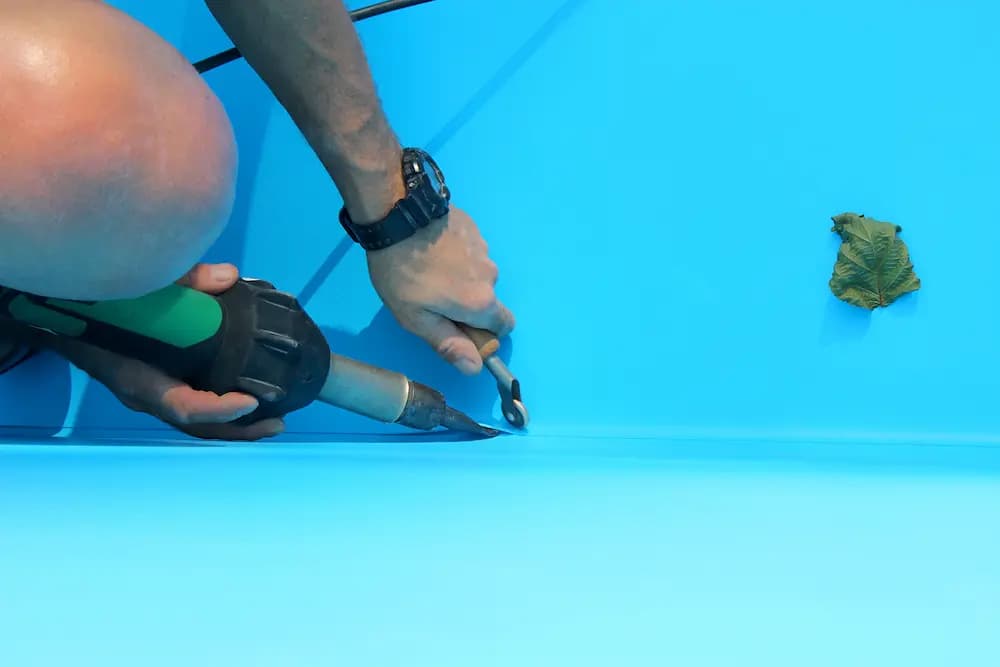
2) Reinforced PVC liner (a “new shell” inside)
A common refurbishment solution when there are multiple micro-leaks or the mosaic finish is at end of life.
- Creates a continuous welded barrier.
- Can be installed over existing substrates after proper preparation.
A strong option when you want durability without fully demolishing the shell.
3) Polyurea and other spray-applied systems
High-performance option where continuity and resilience are key.
- Excellent elasticity and seamless application.
- Requires proper substrate preparation and specialist installation.
4) Cementitious waterproof coatings (under a finish)
Useful as part of a system (e.g., under mosaic or suitable paint), provided the substrate is stable.
- Performs well under water pressure.
- Demands correct detailing at corners, joints, and penetrations.
Common mistakes that shorten service life
- Applying “miracle” products on wet or dirty substrates.
- Ignoring joints and penetrations (skimmer, lights, returns).
- Painting over incompatible finishes or without primer.
- Skipping repairs on active cracks (movement) or structural issues.
Planning for residential communities (Madrid context)
In Madrid, many community pools are refurbished in a rush right before summer. To avoid closures and extra costs:
- Schedule inspections at the end of the season.
- Request a diagnosis that separates shell leaks from pipe leaks.
- Ask for written scope, detailing, and warranty terms.
Signs you may need a full refurbishment
- Constant water loss with no clear point.
- Repeated repairs that only last weeks.
- Broad finish failure (open grout lines, debonding).
- Dampness around the perimeter or adjacent rooms.
Next step
If your pool is losing water or you want a long-lasting pool waterproofing solution, Impermyna can help with diagnosis and a tailored technical proposal in Madrid and Toledo. Get in touch for an assessment and we’ll recommend the most efficient option.
Need help with your waterproofing project?
Our team can review your case and recommend the best long-term solution.
Request a quote