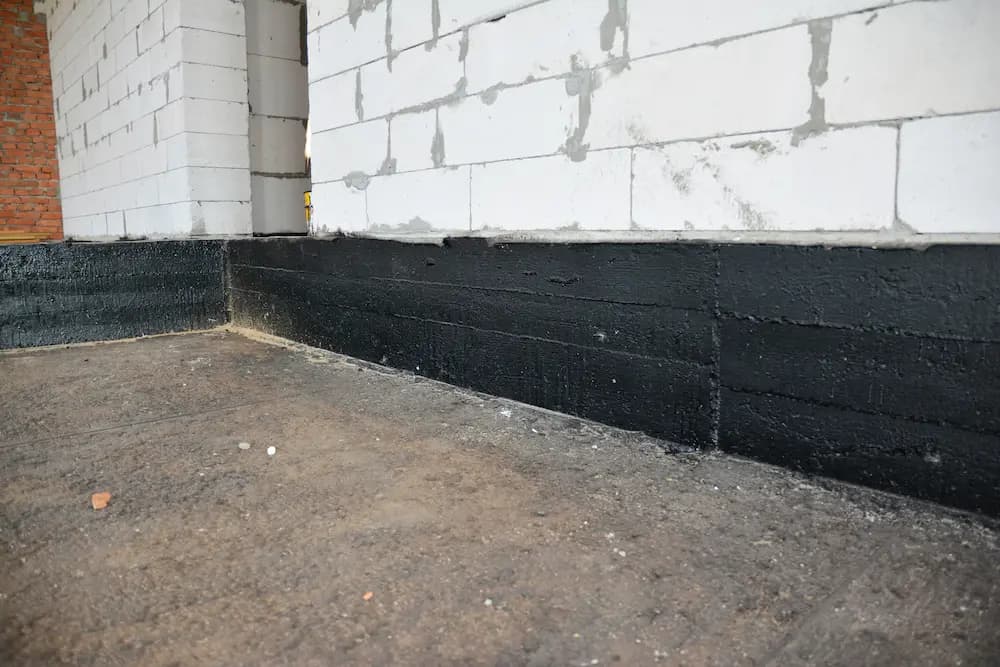
Basement and retaining wall waterproofing becomes especially challenging when water is coming from the ground into the structure. Unlike a roof terrace, basements often suffer negative-side water pressure, meaning water pushes from the outside toward the inside—this changes what systems will actually work.
What is negative-side pressure (and why it matters)?
In below-grade walls, rainwater, irrigation, or a high water table can build up in the soil and press against the wall. Water then finds its way through pores, cracks, joints, or service penetrations, showing up on the interior face.
With negative-side pressure, water is behind any coating applied from the inside, so not every “waterproof paint” or membrane is suitable.
Typical signs of water ingress in basements
- Dark stains or white salts (efflorescence) at wall bases and wall-floor joints
- Blistering paint or crumbling plaster
- Persistent musty smell and secondary condensation
- Localized dripping after heavy rain
- Wet construction joints or pipe penetrations
Diagnosis first: before choosing a system
A reliable solution starts by understanding how and where water is traveling:
- Substrate type: concrete, blockwork, brick, stone
- Weak points: cold joints, cracks, honeycombing, junctions, penetrations
- Water level: dampness, seepage, active flow
- External access: light wells, excavation feasibility, party walls
In Madrid, many issues appear in below-grade car parks and plant rooms within multi-owner buildings, where external excavation is often impractical (access, boundaries, permits). That’s why interior options matter—but they must address the mechanism, not just hide the symptoms.
Common solutions (and when they fit)
1) External waterproofing (the most robust option)
When the outside face of the wall is accessible:
- Waterproof membrane/coating protected by a drainage/protection layer
- Perimeter drainage (drain pipe + gravel) discharged to an approved point
- Proper detailing at joints, corners, and penetrations
This is usually the most durable approach because it stops water before it enters the wall.
2) Cementitious systems from the inside (negative-side)
When excavation isn’t possible, negative-side cementitious waterproofing mortars can be applied internally on properly prepared substrates:
- Demanding prep: remove weak layers, open pores, repair voids
- Reinforce joints and junctions
- Use breathable finishes (avoid plastic paints that trap moisture)
Best for seepage or moderate infiltration when the substrate is suitable.
3) Resin injection (cracks and joints)
Recommended for localized entry through:
- Active cracks
- Cold joints
- Service penetrations
Polyurethane/acrylic resins (case-dependent) are injected to seal the water path. It’s highly effective when the source is correctly identified and executed.
4) Internal perimeter channel + sump pump (water management)
When water is recurrent and external works are not feasible, a managed drainage approach may be used:
- Internal perimeter channel
- Sump chamber
- Controlled pumping/discharge
This doesn’t “waterproof” the wall itself, but it controls water and prevents damage—useful in certain basements, often combined with localized sealing.
Common mistakes in below-grade waterproofing
- Painting over damp walls without preparation: it fails and peels quickly.
- Ignoring joints and junctions: most leaks come from detailing points.
- Mixing up condensation and infiltration: they need different fixes (ventilation/insulation vs waterproofing).
- Sealing inside without addressing pressure: water may reappear elsewhere (floor slab, adjacent wall).
- Skipping drainage on external works: a membrane alone can remain under constant hydrostatic pressure.
Which option is right for a building or home?
A practical rule of thumb:
- If external access is reasonable: external waterproofing + drainage.
- If access isn’t possible and the issue is localized: resin injection.
- If access isn’t possible and seepage is widespread: negative-side cementitious systems, with careful junction detailing.
- If water is persistent and constraints are severe: internal water management (channel + pump), sometimes combined with sealing.
Next step
If you’re dealing with water ingress in a basement, storage room, or car park, the most cost-effective move is a technical inspection to pinpoint the entry path and specify the right system. Impermyna works across Madrid and Toledo with solutions designed for below-grade walls and negative-side pressure. If you’d like, we can help you choose the most durable approach for your case.
Need help with your waterproofing project?
Our team can review your case and recommend the best long-term solution.
Request a quote